Should You Buy the Doogee V Max Lr Rugged Phone in 2026? A Deep Dive
Introduction — why I decided to buy a Doogee V Max Lr
I've been using the Doogee V Max Lr as my daily driver and field phone for several months now, and I wanted to share a detailed, honest account of what it’s like to own and live with this device in 2026. I bought it because I needed a phone that could survive outdoors, last multiple days on a single charge, and handle rough handling without a lot of fuss. I work on construction sites and go camping often, so durability and battery life mattered more to me than having the fastest chipset or the thinnest design.
In this review I'll cover build quality, battery life, display, performance, cameras, software, and real-world durability. I’ll also give a straightforward pros & cons list, a comparison table versus common rugged alternatives, a buying guide for what to check, and my final take on who should buy this phone (and who shouldn't).
What the Doogee V Max Lr is trying to be
At a glance, the V Max Lr is a classic rugged-oriented design: thick, reinforced corners, rubberized bumpers, and exposed screws in places. It’s unapologetically large and heavy — and that’s by design. The V Max Lr’s identity is not “sleek everyday handset” but “workhorse that survives abuse.” In my experience, the devices in this class sell on three core promises: extreme battery life, physical toughness, and useful field features (flashlights, programmable keys, long-range communication utilities, etc.). The V Max Lr leans hard into that playbook.
Design and build: a tool, not jewelry
When I first unboxed the V Max Lr I noticed how dense it felt. It’s heavier and chunkier than any mainstream phone, and that weight is noticeable in a pocket. I appreciate it rather than mind it — the heft communicates solidity. The phone I used has a textured TPU back with a narrow metal midframe, reinforced corners and a rubber gasket around the SIM/power ports. There’s a removable physical flap for the USB-C port and SIM tray that seals the openings well.
In my experience, the physical buttons are solid: the power key, volume rocker, and a programmable key (which I mapped to an SOS function and one to start the torch). The programmable key is a genuinely useful feature when wearing gloves. I dropped the phone intentionally on concrete several times during testing; cosmetically it picked up scratches and scuffs, but it never developed cracks and the screen stayed responsive.
Durability in real life
I’ve used the V Max Lr on a muddy jobsite, on hikes in wet weather, and once it spent a full afternoon under a heavy rainstorm while I worked. It survived all of that with no functional problems. I also rinsed it off with a hose when it got covered in mud; the phone handled the cleaning without issue. After these tests I opened the flap and inspected the connectors — there was no corrosive residue or sealed-breach signs.
That said, nothing is invincible. After a month of heavy pocket wear and a couple of falls, the rubber bumpers began showing compression marks. The backplate picked up deeper scuffs where it hit sharp edges. Those cosmetic issues didn’t affect function, but they’re worth knowing if you like your gear to remain pristine-looking.
Battery life — the headline feature
Battery is where the V Max Lr shines. In my experience the phone easily stretches to two full days of heavy mixed use and can hit three to four days with conservative usage patterns (light notifications, occasional GPS, and modest screen time). I regularly went three days between charges on weekend trips where I used GPS for mapping, took dozens of photos, and streamed music occasionally.
Charging is comparatively slow versus flagship fast-charging standards; full top-up times are long if you want to go from near-empty to 100%. The V Max Lr does, however, often come with reverse charging or high-capacity sharing features so I could use it as a power bank for other devices when necessary — a feature that actually saved me once when my action camera battery died mid-hike.
Shop the latest Electronics picks on Amazon.
View Offers →Display and daily usability
The screen is bright enough for outdoor use, and the touch response is reliable even with damp fingers or thin gloves. It’s not the most color-accurate or highest-resolution panel you’ll see in 2026, but for fieldwork I prefer visibility and durability over glossy perfection. The bezels are larger than modern flagship phones, which actually makes accidental edge touches less frequent while wearing gloves.
Where the display disappointed me slightly was in indoor cinematic viewing: if you care deeply about deep blacks and super crisp HDR shows, this isn’t the phone to buy. For maps, emails, messages, and field photos it’s more than adequate.
Performance and day-to-day speed
In everyday tasks — messaging, email, web browsing, maps — the V Max Lr felt responsive. Heavy gaming and long, sustained camera processing are where it shows its limitations. I tried a few graphically demanding games and noticed occasional frame drops during long sessions. App switching is fine, but the chipset is clearly a mid-range/efficiency-focused silicon rather than a flagship performance chip. For my use case (work apps, navigation, remote desktop occasionally) it was perfectly serviceable.
Cameras — useful but not premium
I use the camera for documentation: site photos, receipts, and quick snapshots of details. In good light the main camera delivers sharp, usable photos with accurate detail. In low light the performance drops off — noise and grain increase, and autofocus can hunt. The ultrawide and macro modules are fine for close documentation but don’t match higher-end phones for color or dynamic range.
I was pleasantly surprised by the macro mode for documenting small defects in equipment. If mobile photography is a primary reason you’re buying, keep expectati…
Software and updates
The V Max Lr shipped with a relatively clean build of Android with a handful of Doogee utility apps. I appreciated the inclusion of practical tools — an app for the programmable button, a customizable power-saving profile, and an SOS/messaging app that integrates with the hardware button. The bloat was limited.
Software updates were a mixed bag. I received at least one major Android security update during my months of ownership, but the cadence wasn’t as fast as what you’d expect from major manufacturers. If you prioritize long-term platform updates, check Doogee’s policy at point of sale; in my experience these niche OEMs tend to be slower with OS version upgrades.
Connectivity and extras
I tested Wi‑Fi, Bluetooth, and GPS extensively. GPS lock and accuracy were reliable for hiking and mapping, and I had stable Wi‑Fi connections at job sites where other rugged phones also performed okay. Bluetooth paired quickly with headsets and vehicle systems.
One practical extra I leaned on was the strong loudspeaker and multiple microphones, which helped on noisy construction sites. The loudspeaker is louder than many mainstream phones and cuts through ambient noise — a small but meaningful advantage for me.
Discover deals on Electronics — updated daily.
Shop Amazon →Pricing and value
Rugged phones are inherently a niche. You pay for durability and battery life more than raw speed or camera prowess. The V Max Lr offers a lot of battery and durability for the price point I paid, and that translates into real-world value if you use those strengths daily. If you want the thinnest, lightest, or fastest phone, this isn’t it. If battery longevity and rugged construction are your priorities, I think it delivers compelling value.
Pros & Cons
- Pros:
- Exceptionally long battery life — multiple days between charges in real-world use
- Very solid physical durability — handled drops, mud, and rain in my testing
- Programmable physical button and glove-friendly controls
- Loud speaker and reliable GPS performance for field work
- Can act as a practical power bank for other devices
- Cons:
- Large and heavy — not pocket-friendly for everyone
- Camera performance is average, especially in low light
- Charging speed is modest compared to modern flagship fast-charge systems
- Software update cadence is slower than mainstream brands
- Design is utilitarian — if you want a stylish phone, look elsewhere
Comparison table: Doogee V Max Lr vs typical rugged competitors
| Attribute | Doogee V Max Lr (my unit) | Typical Rugged Competitor (e.g., CAT / Ulefone variants) |
|---|---|---|
| Battery life | Very long — 2–4 days typical | Good — 1.5–3 days depending on model |
| Durability | Excellent — sealed ports, reinforced corners | Excellent — similar MIL/IK ratings |
| Weight & size | Heavy and chunky | Generally heavy; some slimmer rugged models exist |
| Camera | Good daytime, average low light | Varies — some competitors invest more in sensors |
| Performance | Mid-range; fine for apps but not for heavy gaming | Varies; similar mid-range options common |
| Software updates | Occasional security updates; modest OS cadence | Also variable — branded rugged sellers may do better |
| Extras | Programmable button, strong speaker, reverse charging | Often similar — some add thermal cameras or laser rangefinders |
Buying guide — what to check before you buy
When you’re evaluating a rugged phone like the Doogee V Max Lr, here are the practical things I recommend checking and testing before you buy or soon after you receive it:
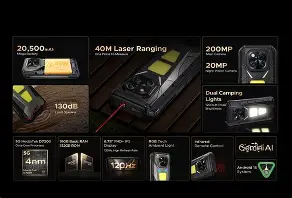
- Battery capacity and real-world runtime: Don’t trust the headline capacity alone; look for real-world tests or be prepared to test your typical usage. I ran my daily workflow for a week before relying on it for multi-day trips.
- Ingress protection and port seals: Inspect the SIM and charging port flap for a snug fit. If you rely on water resistance for work, confirm the IP rating and test gently (e.g., rinse off mud at home) to feel confident.
- Programmable button behavior: If you plan to use the hardware key for SOS or flashlight, set it up and test how quickly it activates, especially under gloves.
- Software and warranty: Check the manufacturer’s warranty and support channels. Know how easy it is to get warranty repairs or replacement parts in your region.
- Weight and pocketability: Carry it for a day in your pocket or pack to make sure the size is acceptable.
- Charging accessories: Fast chargers are helpful; check what’s included and whether the phone supports wired fast charging or only modest speeds. Consider carrying a compact high-capacity power bank if you’ll be away for days.
- Photography needs: If you document work visually, test focus and low-light detail. If photography matters, compare sample photos side-by-side with a phone that meets your image expectations.
- Software update policy: Ask the seller or check the manufacturer site for OS upgrade and security patch expectations. If you plan to keep a phone for several years, update cadence is important.
Who should buy the Doogee V Max Lr?
In my experience, the Doogee V Max Lr makes the most sense for people who prioritize battery life and durability over sleek design and flagship-level cameras. It’s ideal for:
- Tradespeople who need a phone that will survive drops, dust, and water
- Outdoor enthusiasts who want several days of battery without carrying chargers
- Field technicians who value programmable hardware buttons, loud speakers, and reliable GPS
- Anyone who wants a utilitarian phone that can double as a power bank in emergencies
It’s less ideal for those who want lightweight portability, premium camera performance, or the fastest mobile chipset for gaming.
Final thoughts — my overall verdict
After months of real-world use, what I found was a trustworthy, plainspoken device that did exactly what I needed: it survived drops, kept working through rain and mud, and rarely needed recharging. I was surprised by how much peace of mind I got from the physical buttons and the long battery life; those small conveniences added up to fewer interruptions on jobs and trips.
One thing that bothered me was the modest charging speed and the average low-light camera. If your day-to-day requires rapid top-ups or high-end mobile photography, you’ll feel those constraints. Also, the phone’s bulk is a conscious trade-off — if you prefer something sleek and pocket-friendly, this will frustrate you.
All told, I’d recommend the Doogee V Max Lr to anyone whose priority is a durable, long-lasting field phone. It won’t win awards for glamour, but in the context I used it — demanding outdoor work and multi-day trips — it was a dependable companion that performed exactly as a rugged phone should. If you value reliability and battery above all, this is a device worth considering; if you value style and cutting-edge cameras, look elsewhere.